TOC
1Introduction
The Buyer Journey Has Changed — Permanently.
The B2B buyer has changed faster in the last two years than in the previous twenty.
Buyers are no longer just self-directed.
They are AI-assisted, AI-influenced, and increasingly AI-mediated.
Large language models now shape vendor shortlists before your sales team even knows an account is in market. Buying committees are expanding. Research cycles are compressing. And the traditional MQL-driven funnel is breaking under the weight of a new reality.
Yet many go-to-market strategies are still structured around a model built for a different era:
- Form fills as the primary signal of intent
- Linear nurture tracks
- Static segmentation
- SEO as the only discovery engine
- Lead scoring models designed for individuals, not buying groups
These systems were built for a buyer journey that no longer exists.
The organizations winning today are rebuilding their go-to-market strategy around an AI-first buyer experience — one that aligns marketing, sales, and customer success around how modern buyers actually research, evaluate, and purchase solutions.
The Modern Buyer Journey Starts Before Your Funnel
Most B2B revenue systems are built around a simple idea: generate interest, capture a lead, move it through stages, and convert it to pipeline.
Unfortunately, that’s not how buying actually works anymore.
In reality, buying often begins long before a form fill or demo request. Internal conversations happen. Budget pressure builds. Leaders compare options informally. Peers share recommendations. Preferences start forming quietly inside the organization.
By the time someone shows up in your CRM, a buying process may already be underway.
Your funnel didn’t start the journey — it revealed it.
That distinction matters.
From Lead Generation to Buying Detection
Traditional demand generation focuses on pushing buyers forward: launch a campaign, drive engagement, increase conversions.
Modern demand orchestration focuses on detecting buying motion already forming inside target accounts.
Instead of asking, “How do we generate more leads?” revenue teams should be asking:
- Are multiple stakeholders engaging?
- Is research happening at the account level?
- Are we seeing cross-role activity patterns?
- Are competitors being evaluated?
A single content download is noise. But, coordinated engagement across finance, operations, and IT is signal.
The shift from isolated leads to multi-stakeholder patterns is one of the defining changes in the modern buyer journey.
Much of the industry’s current understanding of modern B2B buying has been shaped by research from analysts and practitioners studying how complex purchases actually unfold.
Kerry Cunningham, Head of Research and Thought Leadership at 6sense, has been particularly influential in reframing the shift from lead generation to buying detection, emphasizing that revenue teams must identify coordinated buying behavior across accounts rather than rely on isolated lead activity.
Buying Groups, Not Individuals
Complex B2B purchases are rarely made by one person. They’re made by buying groups navigating risk, budget, and internal alignment.
That means:
- Accounts should be scored based on buying group engagement, not individual behavior.
- Messaging should reflect persona-specific concerns.
- Outreach should be coordinated across the committee.
- Paid, owned, and earned channels should work together to “surround” the group.
This is where signal platforms, enriched CRM data, and structured ABM strategies become critical. They allow teams to identify who is involved and respond with precision.
Visibility Now Extends Beyond Your Website
Today’s buyers don’t just research on vendor sites. They validate vendors through peer networks, analyst commentary, review platforms, and increasingly, AI-driven search experiences.
AI Engine Optimization (AEO) is now part of the buyer journey. Buyers are using large language models to compare providers, summarize capabilities, and pressure-test vendor claims. If your brand is not visible or accurately represented in those environments, you may be excluded from evaluation before your sales team ever engages.

Modern B2B marketing is less about pushing buyers through predefined stages and more about:
- Detecting buying groups in motion
- Building preference before formal evaluation
- Coordinating engagement across stakeholders
- Improving win probability once buying begins
The buyer journey hasn’t become more linear.
It has become more opaque and more collective.
The advantage now goes to revenue teams that can see earlier, respond smarter, and align their systems to how coordinated human decision-making actually works.
The Modern Buyer Journey Is Collective and Signal-Driven
Before we explore the go-to-market shifts required to adapt, it’s important to clarify a few concepts shaping the modern buyer journey.
Definitions & Explanations: A Quick Glossary for the Modern Buyer's Journey
What are buying committees in B2B?
Most complex B2B purchases are made by groups of stakeholders rather than a single decision maker. These buying committees, often called buying groups, typically include representatives from multiple functions such as finance, operations, IT, procurement, and executive leadership.
Each stakeholder evaluates the purchase through a different lens—risk, cost, implementation, and strategic value. Modern go-to-market strategies must account for these multi-stakeholder dynamics rather than focusing solely on individual leads.
What are signal platforms?
Signal platforms and buyer intent data providers help revenue teams identify early buying activity at the account level.
Rather than relying on form fills or individual conversions, these platforms aggregate behavioral data from multiple sources—website visits, content engagement, third-party research activity, and intent data—to detect patterns that suggest a buying group is actively researching solutions.
This shift from individual leads to account-level buying signals is central to modern demand orchestration.
What is enriched CRM data?
Enriched CRM data combines your internal customer data with external firmographic, technographic, and contact data to create a more complete view of target accounts.
Enrichment tools add missing information such as company size, industry, technology stack, and additional stakeholders within an organization. This helps revenue teams better identify buying groups, personalize outreach, and coordinate engagement across marketing and sales.
What is buying detection?
Buying detection refers to the ability to identify coordinated buying behavior across multiple stakeholders within a target account.
Rather than waiting for an individual lead to raise their hand, revenue teams analyze engagement patterns across roles and channels to determine when an organization may be entering an evaluation process.
This concept has been popularized by research from industry analysts such as Kerry Cunningham of 6sense, who argues that modern revenue teams must focus less on generating leads and more on detecting buying motion already underway.
2The Shift: From the Linear Funnel to the AI-First Buyer Journey
The Old, Linear Journey
For years, B2B go-to-market followed a predictable pattern:
Blog → Website → Form Fill → MQL → SDR → AE → Close
Once upon a time, you could easily map the buyer's journey like in the imagine below. Now? It's closer to a wheel where indicators converge to tell a larger story.
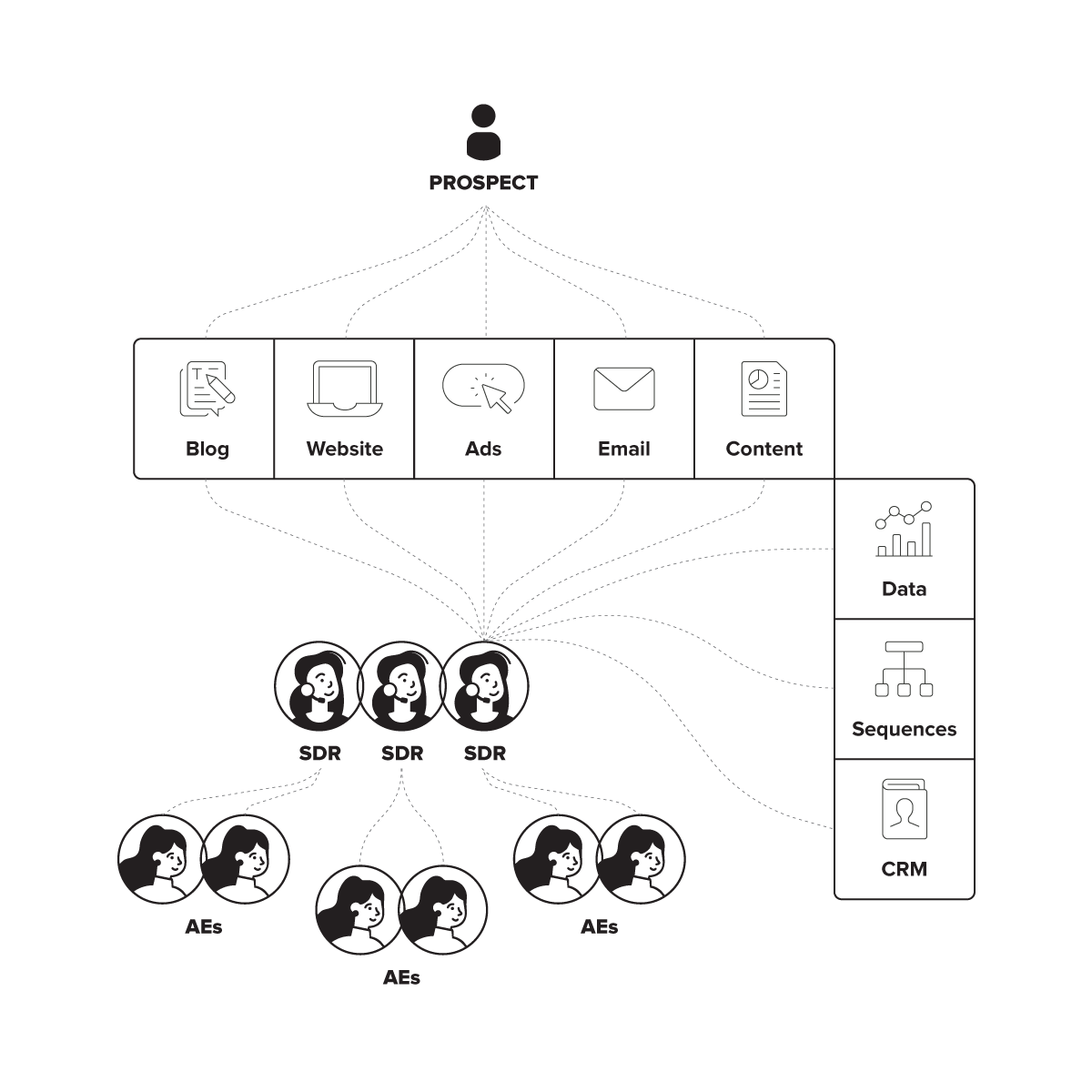
This model assumed:
- Buyers moved sequentially.
- Marketing generated leads.
- Sales converted them.
- Vendors controlled pacing.
- Intent was measured by form submissions and email opens.
But today’s buyer journey looks radically different.
Instead of progressing neatly through stages, buyers:
- Conduct independent research using AI tools
- Compare vendors via peer reviews
- Validate through private communities
- Involve multiple internal stakeholders
- Engage vendors only after forming strong preferences
Change in Directions

The old journey was vendor-led.
The new journey is buyer-determined.
And it’s driven by signals.
The New Buyer’s Experience
The transformation can be summarized across six fundamental dimensions.
What's Changed in Buying Journeys


1. Process: From Linear to Non-Linear & Signal-Driven
Before AI:
Awareness → Consideration → Decision.
Today:
Research begins long before vendor interaction.
Buying committees self-align.
Vendors are brought in late to validate decisions.
The journey is no longer stage-based. It’s signal-driven. Buyers leave behavioral clues across channels, platforms, and ecosystems. Your systems must detect and respond in real time.
2. Information: From Vendor-Controlled to AI-Curated
Previously, vendors controlled information flow:
- Websites
- Whitepapers
- Sales decks
- Analyst reports
Today, AI curates the buyer’s information set:
- ChatGPT comparisons
- AI-generated vendor shortlists
- Summaries of peer reviews
- YouTube breakdowns
- Community commentary
If your content cannot be surfaced, understood, and trusted by generative engines, you are invisible during early research.
This is where AEO, Answer Engine Optimization, becomes mission-critical.
3. Indicators: From MQLs to Behavioral Signals
The MQL was built for a world of gated content and single-threaded engagement.
But buying is no longer individual.
It is committee-based.
One contact downloading an ebook is not intent.
Five stakeholders researching pricing, integrations, and competitor comparisons is.
Modern demand strategy requires moving beyond static segmentation toward dynamic signal orchestration:
- First-party signals: Website visits, CRM activity, lifecycle stage movement
- Second-party signals: Review platforms like G2
- Third-party signals: Intent platforms like SixthSense
- Conversational signals: Call summaries and AI-analyzed deal notes
Signal convergence, not form fills, now defines opportunity.
The death of the MQL is not dramatic rhetoric. It’s structural reality.
4. Speed: From Vendor-Led to Buyer-Determined
Buyers now expect:
- Instant research synthesis
- Highly personalized demos
- Tailored proposals in days, not weeks
- Immediate access to technical detail
AI compresses research cycles. That means your response systems must be just as fast.
Speed has become a competitive advantage.
5. Personalization: From Segments to Context-Aware AI
Old personalization meant:
- Industry segmentation
- Generic nurture tracks
- Limited workflow branching
New personalization means:
- Account-level intent scoring
- ICP + signal-based messaging
- Role-specific content for each buying committee member
- AI-generated summaries tailored to deal context
This is orchestration and automation working together to meet buyers where they want vendors to be.
6. Trust: From Built to Earned
Trust used to be built through:
- Sales conversations
- Vendor-produced content
- Analyst reports
Now it is earned through:
- Peer reviews
- AI-cited sources
- Private Slack communities
- Social networks
- Influencer content
Your brand is increasingly validated by third-party ecosystems and by AI’s interpretation of them.
3The Four GTM Shifts Required to Win
The New AI-First Journey
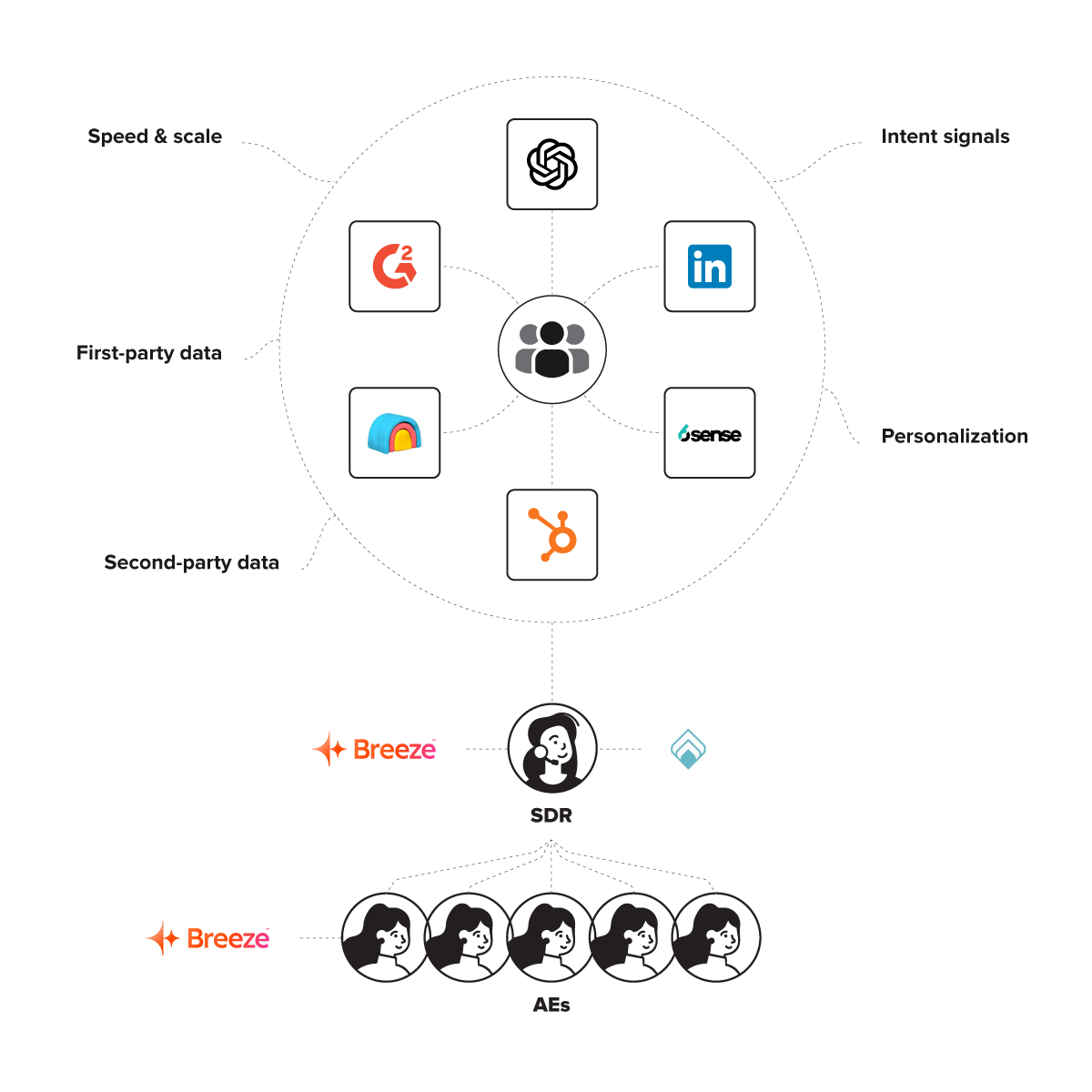
Breaking Down the Shifts in the Modern Buyer's Journey

Shift 1: From MQLs to Buying Committees
Buying is identifying and engaging the full buying group, rather than about a single lead.
That requires:
- Mapping all stakeholders at target accounts
- Understanding who signs contracts
- Aligning marketing, SDR, and sales around accounts — not individuals
- Scoring accounts differently when multiple stakeholders engage
- Building a “plan for every contact”
The unit of engagement has become the account, not the lead as it once was.
Shift 2: From Segments to Signals
Segments tell you who, when, how to prioritize.
Modern signal orchestration requires:
- Combining first-, second-, and third-party data
- Identifying intent convergence
- Distinguishing signal from noise
- Aligning marketing and sales activation
Signals without orchestration create confusion.
Signals + convergence create clarity.
Shift 3: From SEO to SEO + AEO
Search behavior is shifting. Buyers increasingly ask generative engines for:
- Vendor comparisons
- Implementation guidance
- Pricing benchmarks
- “Best tools for…”
AEO ensures:
- Your content addresses real research queries
- Your expertise is visible in AI outputs
- Your brand is cited in generative environments
- You influence the research phase — not just the conversion phase
SEO still matters. But discoverability now extends beyond Google..
Shift 4: From Automation to AI-Orchestrated GTM
Most organizations rely on isolated automations:
- Email workflows
- Lead scoring rules
- Task assignments
But AI-orchestrated GTM connects marketing, sales, and customer success in real time.
Examples include:
- AI-driven personalization at scale
- Prospecting agents that surface high-intent accounts
- AI-generated call summaries aligned to qualification frameworks
- Churn prediction models triggering proactive outreach
The difference is profound:
- Automation executes tasks.
- AI orchestration coordinates systems.
4A Practical Framework: Building an AI-First Buyer Journey
Securing buy-in and aligning your team
Migration success depends on alignment across the organization. Your project team should include stakeholders across marketing sales, operations, and IT.
By obtaining endorsement from key stakeholders across functions, you set expectations for CRM utilization and secure the necessary resources for the project.
The following best practices will help ensure you engage them appropriately.
Four Steps to Follow to Operationalize Shifts in B2B Buyer Behavior


Step 1: Remap the Journey
Ask:
- Who is on your buying committee?
- How are they using AI in research?
- Where do they consume information?
- What emotional and rational drivers influence decisions?
- How does your brand show up in LLM outputs?
Then:
- Analyze win/loss data
- Interview customers
- Map emotional and rational content needs
Align your sales process to the updated journey.
Step 2: Identify Gaps & High-Impact Use Cases
Common gaps include:
- Legacy lead scoring models
- SDRs manually researching accounts
- Outdated personas
- Underutilized AI tools
- Missing content for buying committee members
Prioritize based on:
- Business impact
- Speed to implement
You don’t need to fix everything at once.
Start where impact meets velocity.
Step 3: Configure Tools & Data
AI is only as powerful as the systems behind it.
Evaluate:
- Structured data (clean fields, firmographics, lifecycle data)
- Unstructured data (call notes, sales transcripts, playbooks)
- Intent data integrations
- Marketing–sales alignment
- Underutilized AI capabilities in your tech stack
Your goal: Build an AI-ready data infrastructure.
Step 4: Enable a Culture of Experimentation
Technology adoption is cultural.
Assess:
- Team AI competency
- Shadow AI usage
- Training gaps
- Guardrails for experimentation
Encourage:
- Hackathons
- Pilot programs
- Fast iteration cycles
Think of AI maturity as an operating model, not as a toolset.
Connecting Strategy to Execution
This framework directly supports modern growth services:
- Growth Strategy Workshops: Persona validation and buying committee mapping
- ABM Readiness: ICP refinement and signal orchestration
- AEO Implementation: AI visibility and generative discoverability
- Strategic Roadmaps: AI readiness and GTM re-architecture
This pillar is practical.
The Companies That Will Win
The next generation of B2B leaders will not win by:
- Generating the most MQLs
- Sending the most emails
- Automating the most workflows
They will win by:
- Detecting signal convergence earliest
- Surrounding buying committees intelligently
- Showing up inside AI research environments
- Orchestrating marketing, sales, and customer success in real time
They will treat AI not as a feature, but as infrastructure.
And they will re-architect their go-to-market strategy accordingly.
Want to Evaluate How Your GTM Strategy Aligns With the Modern Buyer Journey?
Many revenue teams are still operating with systems and metrics designed for an earlier era of B2B buying. If you're unsure how your current strategy stacks up against the realities of AI-assisted research and buying group behavior, we can help.
Our team works with companies to evaluate their demand model, RevOps infrastructure, and buyer engagement strategy to identify opportunities for modernization.
Frequently Asked Questions about How AI Tools are Changing B2B Vendor Selection
What is the modern B2B buyer journey?
The modern B2B buyer journey is increasingly self-directed, multi-stakeholder, and AI-assisted. Buyers conduct extensive research before engaging with vendors and often involve multiple departments in evaluation. This means revenue teams must focus on identifying buying groups, detecting early research activity, and coordinating engagement across stakeholders rather than relying solely on individual lead capture.
Why is the traditional MQL model breaking down?
The traditional MQL model was designed for a time when individual buyers discovered vendors primarily through marketing channels and converted through form fills.
Today, most research happens anonymously and across multiple stakeholders, often before any form is submitted. As a result, MQLs capture only a small fraction of actual buying activity, making them a weak signal of real purchase intent.
What is an AI-first buyer journey?
An AI-first buyer journey reflects the growing role of AI tools and large language models in how buyers research vendors, compare solutions, and validate decisions.
Buyers increasingly rely on AI-driven search, summaries, and recommendations during early research phases. This means companies must ensure their expertise, brand, and solutions are visible and accurately represented in AI-powered discovery environments.
How should B2B companies adapt their go-to-market strategy?
Modern go-to-market strategies must shift from lead generation to demand orchestration. This includes identifying buying groups at the account level, detecting signals of active research, aligning marketing and sales outreach, and engaging multiple stakeholders simultaneously.
Organizations that coordinate engagement across the buying committee are better positioned to influence decisions earlier in the evaluation process.
What role does intent data play in modern B2B marketing?
Intent data helps revenue teams identify when target accounts are actively researching specific problems or solutions. When combined with CRM data, engagement signals, and account insights, intent data can help teams prioritize accounts that are most likely to be entering a buying cycle.
What is demand orchestration?
Demand orchestration is an approach to go-to-market strategy that focuses on coordinating engagement across the entire buying group and multiple channels rather than simply generating individual leads.
Instead of pushing buyers through predefined funnel stages, demand orchestration prioritizes identifying buying groups that are already researching solutions and aligning marketing, sales, and customer success around those signals.
This approach combines account-level insights, intent data, enriched CRM data, and coordinated outreach to influence the buying process earlier and improve the likelihood of winning deals.
How does AI change vendor discovery?
AI tools and large language models are becoming a new layer of vendor discovery. Buyers increasingly use AI assistants to summarize vendors, compare capabilities, and shortlist solutions before engaging with sales teams.
If a company’s expertise and reputation are not well represented in these environments, they may be excluded from consideration early in the buying process.
How are AI tools changing B2B vendor selection?
AI tools and large language models are becoming a new layer of vendor research and evaluation in B2B buying. Instead of relying solely on search engines or vendor websites, buyers increasingly use AI assistants to summarize vendors, compare capabilities, and generate shortlists.
These systems synthesize information from websites, analyst reports, reviews, and public content to provide recommendations. As a result, vendor visibility now depends not only on traditional SEO but also on how clearly expertise, credibility, and product capabilities are represented across the broader digital ecosystem.
For revenue teams, this means optimizing for AI-driven discovery as well as traditional search.
Why are buying groups important in B2B sales?
Most B2B purchases involve multiple stakeholders who evaluate different aspects of a potential solution. These stakeholders form a buying group, often including roles from finance, operations, IT, procurement, and executive leadership.
Research into modern buying behavior has shown that decisions are rarely made by a single individual. Instead, purchasing decisions require consensus across the group.
This means revenue teams must move beyond individual lead tracking and instead identify and engage the broader buying committee. Successful go-to-market strategies coordinate messaging, outreach, and content across multiple roles within the account.