The Essential Guide to Demand Generation
Demand Generation Guide: Strategy, Tactics, and Technology for Sustainable Growth

TOC
1Introduction: What is Demand Generation?
A proven, cross-functional strategy
Growth doesn’t come from focusing on just one stage of the funnel. The most effective revenue teams take a holistic approach—driving awareness, engagement, conversion, and expansion across both new and existing customers.
That’s where demand generation comes in.
Demand generation is a data-driven, full-funnel strategy focused on creating awareness, building trust, and driving revenue across the entire customer lifecycle. It connects marketing, sales, and customer success to deliver a cohesive experience—from first touch to long-term expansion.
At its core, demand generation brings together multiple functions, including:
- Brand awareness
- Content and inbound marketing
- Sales enablement
- Customer engagement and retention
Together, these efforts help companies attract the right audiences, convert them into customers, and continue delivering value over time.
How Is Demand Generation Different from Inbound Marketing?
While the terms are often used interchangeably, demand generation and inbound marketing are not the same.
Inbound marketing is a methodology focused on attracting potential customers by providing valuable, relevant content and educational experiences. It builds trust by helping buyers solve problems and make informed decisions—often before they ever speak to sales.
Inbound is a critical component of modern marketing strategies, but it represents just one piece of the puzzle.
Demand generation is the broader strategy. It includes inbound marketing, but also extends beyond it to incorporate paid media, sales alignment, lifecycle marketing, customer success, and revenue operations.
In other words:
- Inbound marketing drives attraction and engagement
- Demand generation connects that engagement to revenue
A successful demand generation strategy ensures that marketing, sales, and customer success teams are aligned: supporting customers through acquisition, retention, and expansion.
2The Foundation of a Successful Demand Generation Strategy
Defining Your Ideal Customer Profile (ICP) and Building Buyer Personas
Before executing campaigns, organizations need a strong strategic foundation.
Successful demand generation strategies require a deep understanding of who you’re targeting. That means aligning your organization around both buyer personas and ideal customer profiles (ICPs).
While these concepts are closely related, they serve different purposes—and both are essential to targeting, messaging, and conversion.
What Is an Ideal Customer Profile (ICP)?
An ideal customer profile (ICP) defines the types of companies that are the best fit for your product or service.
These are the organizations most likely to:
- See value in your offering
- Convert efficiently
- Retain and expand over time
ICP criteria often include:
- Industry
- Company size
- Revenue
- Business model
- Technology stack
In short, your ICP defines which companies you should target.
What Is a Buyer Persona?
A buyer persona represents the individuals within those companies who influence or make purchasing decisions.
Personas typically include:
- Job title and role
- Goals and priorities
- Pain points and challenges
- Buying motivations
- Preferred channels and content formats
If your ICP defines the account, your personas define the people within that account.
Check out our Field Guide to Buyer Personas to dive deeper.
Using ICPs and Personas to Improve Demand Generation
When properly defined, ICPs and personas become foundational to every part of your demand generation strategy, including:
- Campaign targeting and segmentation
- Content creation and messaging
- Channel selection and media spend
- Sales outreach and conversations
- Customer experience and lifecycle marketing
They help your teams prioritize high-fit opportunities and deliver more relevant, personalized experiences across the funnel.
Keep Your ICPs and Personas Up to Date
Buyer behavior, market conditions, and your own product positioning will evolve over time—so your ICPs and personas should evolve as well.
At minimum, revisit them annually by:
- Analyzing campaign and revenue performance by persona and segment
- Leveraging data enrichment tools for deeper insights
- Gathering feedback from sales, marketing, and customer success teams
This ongoing refinement ensures your demand generation efforts stay aligned with the audiences most likely to drive sustainable growth.
Setting Strategic Growth Goals
Once you've defined your ICP and buyer personas, your organization will need to align on the outcomes you are looking to drive with your demand gen program. Key foundational components of this work include identifying the audiences you are targeting, the revenue goals you hope to attain, your highest-value products and services, and your highest-value customers.
While this process may seem straightforward, many organizations can overlook key opportunities simply because they either lack an aligned internal revenue structure or lack consistency in how they leverage data and map marketing performance indicators to revenue targets.
Goal-setting for predictable revenue
Effective goal setting is essential for demand generation. Many organizations map marketing “KPI’s” to business revenue targets using their own internal performance benchmarks and common industry benchmarks for performance “across the funnel” (traffic, contacts, leads, MQLs, SQLs, opportunities, Closed-Won). While this is a useful starting point, a more detailed approach to data modeling and analysis will help you generate more predictable and measurable results, forecast with greater accuracy, and focus your marketing resources on the right activities.
To achieve this, start by assessing both your historic marketing performance across your funnel, and the corresponding sales impact and deal velocity associated with your marketing performance.

At what rate did these leads translate into opportunities?
How long was the average sales cycle?
How large was the average associated deal?
With this type of analysis you can now set a new strategic foundation and set specific, measurable, actionable, realistic and timely goals aligned to where you are seeing the largest funnel gaps.
Moreover, this foundation will inform the types of tactics you’ll want to deploy to address them along with associated key performance indicators, leading performance indicators and tactical performance indicators. In all cases, these metrics should ladder to defined revenue objectives to ensure your teams focus their efforts on results, not just actions and activities.
Building a Tech Stack for Growth
Whether you are a marketer, a CEO, a sales rep or a customer service team member, your ultimate success depends on your technology stack. From orchestrating a multichannel campaign to scoring, routing, and following up on leads, the volume of deliverables and touchpoints required in today’s digital world requires lockstep alignment between multiple systems, with clean data throughout.
When building out your tech stack, you have the option to choose between an extensible platform or a collection of tools that specialize in a single area or tactic.
Extensible platforms like HubSpot are all-in-one and allow you to run your entire demand generation strategy from a single place. Specialized tools only help you with a single strategy, but because of that, they can be more specialized and contain advanced features you may require.
Regardless of budget or the size of your tech stack, you need a system that can accommodate all key aspects of your demand generation program.
A Winning Demand Generation Stack Includes:
1
Customer Relationship Management (CRM):
Designed to manage interactions with your prospects and customers, your CRM typically includes sales outreach capabilities, sales acceleration tasks like email templates and automation, data storage as well as typically offering some level of reporting and analytics. Your CRM is the hub of information that your business is run on and should be at the center of a thriving B2B company’s techstack.
2
Content Management System (CMS)
Critical to manage and the volume and types of content that fuel your lead generation efforts, a CMS allows non-developers to generate and publish content to your company website. A CMS is essential for assets like landing pages, blog posts, A/B testing, forms and the ability to report on all of those features
3
Marketing Automation Platform (MAP):
Centered around nurturing leads, a marketing automation platform (MAP) is intended to automate and manage your marketing team’s tactics. Those tactics can include email automation, conversational marketing, form strategy, landing pages, call-to-actions and social media management.
4
Reporting or Analytics:
A reporting or analytics software will enable you to track how your teams’ efforts are performing as well as understand things like funnel metrics, conversion rates and attribution.
Other Platforms to Consider to Execute Demand Generation Strategies

A video hosting platform
Sales can use video to engage with prospects through email, and videos on your website can help educate visitors on your product or service. But in order to work video into your demand generation strategy, you will need a platform that is dedicated to hosting those videos so that you can embed them onto your site or insert them into emails. Some commonly used platforms are: Zoom, Vidyard, Wistia.
AI agents and conversational experiences
Using AI-powered agents, chatbots, or live chat on your site can increase conversions and improve user experience. To implement these experiences, you’ll need a platform that allows you to build automated conversation flows while enabling your sales or customer success teams to step in when needed.
Sales intelligence tools
Manual data entry can be one of the most tedious aspects of a sales reps job, and one that can have serious repercussions if mistakes are made. Sales intelligence tools can automatically enrich leads in your CRM, filling in information like company size, location or other information that is critical for your sales team. Tools like this can make prospecting easier for sales reps and keep your database cleaner.
SEO and AEO tools
Your keyword strategy is a key part of demand generation. To drive organic growth, you need tools to research, track, and analyze keyword performance. As search evolves, it’s also important to optimize for Answer Engine Optimization (AEO), ensuring your content is structured and accessible for AI-driven search experiences. More advanced platforms can also track competitors and monitor keyword rankings over time.
Social media tools
While social media platforms like Linkedin, Instagram and Twitter are free to users, there are tools out there that make your businesses social strategy more targeted and aligned with the goals of your business. With paid tools you can follow trends and hashtags closely, plan and schedule posts and manage multiple accounts all in one place.
Project management software
A demand generation strategy involves a lot of moving parts, and all team members need to be aware of what’s in-flight, what’s coming up and what they’re personally responsible for. A project management tool can help you monitor the progress of all your efforts and keep team members informed for optimal collaboration.
Graphic design software
Depending on your team's level of design expertise, consider investing in software that allows for deep creativity on assets like graphics, blog images, infographics, website designs, email templates and anything else that represents your brand.
The amount of options available to teams is overwhelming to say the least, but you don’t have to have all of those platforms in order to see success. Build a tech stack that supports your company size, team size, technical training capability, budget requirements and user preferences.
Whatever tech stack you build, make sure it’s condensed, utilized and interconnected. If your tech stack operates in silos, so will your teams.
3The Core Components of Demand Generation
Brand Awareness
While brand building and demand generation marketing are different disciplines, your brand identity plays a key role in driving the efficacy of your demand gen program, particularly when it comes to your Inbound marketing strategy.
Four key brand-related work streams are essential for success, all of which are centered on driving the high level recognition, trust, and awareness your audience needs in order for them to feel comfortable giving you their personal information and entering your sales “funnel.”
The Four Demand Generation Work Streams


Brand Platform
Your brand platform should reflect everything your company stands for, represents, and believes in as well as the way you interact with the individuals who come in contact with your company and the experience you create for them.
Your brand platform will vary in detail depending on your business, but typically consists of your logo and creative platform, positioning and messaging platform, and brand guidelines. All of this should be developed and tested to resonate with your buyer personas and ICP’s, ideally prior to going to market with your demand generation strategy.
Industry Thought Leadership
“Thought leadership” can often be conflated with content marketing or even a single workstream like blogging or PR. In truth, thought leadership is a key component of your overall content strategy focused on driving a clear point of view on topics you want to be known for.
The most effective strategies for building thought leadership begin with organizational alignment around critical industry topics, and content development and syndication that communicates your organization’s perspective, including:
- Regular blogging featuring SMEs from your company and broader industry
- Partnering with leading industry publications your personas read and syndicating content through those channels
- Establishing a newsletter of company and curated content
- Actively participating in discussions pertaining to your industry on forums or social networks like Reddit, Quora, and LinkedIn
Social Media Presence
Social media plays a critical role in modern demand generation—not just for brand awareness, but for content distribution, audience engagement, and thought leadership.
Platforms like LinkedIn and YouTube are where buyers go to discover ideas, evaluate vendors, and validate credibility. As a result, social has become a key channel for extending reach beyond your website and influencing pipeline.
In addition to organic content, social platforms offer powerful paid targeting capabilities, making them effective for amplifying campaigns and reaching high-fit audiences at scale. A strong strategy combines consistent organic presence with paid promotion to maximize visibility and impact.
However, it’s not necessary to invest equally in every platform. The most effective strategies focus on the channels where your audience is most active and where your content naturally fits.
For many B2B organizations, LinkedIn serves as the foundation for both thought leadership and paid distribution, with other channels layered in based on your goals. For example, YouTube can support deeper educational content, while other platforms may help showcase brand and culture.
The most effective social strategies combine consistent content, paid amplification, and direct audience engagement.
Public Relations Management
Maintaining a mutually beneficial relationship between the public and your organization is vital to expanding your brand. Fortunately, PR can also be applied to your demand gen strategy through press releases, contributed articles, and earned media approaches among other tactics.
Press releases represent a proven foundational tactic. A steady cadence of news announcements will showcase important milestones at your company to the business world as well as contribute to your reputation in the industry. Releases can also be used to highlight awards or certifications your company receives that reflect on your company’s accomplishments or culture.
However, in implementing your PR strategy, it’s essential to consider where the release is distributed. The difference in traffic and impact between a release that just sits on company page and one that is picked up by TechCrunch is significant, so partnering with a PR agency that has the right media connections aligned to the watering holes of your ICPs & Target Personas is important.
Tactics and Strategies for Success
Now that you have a scalable tech stack, as well as clearly define goals, personas and ideal customer profile, you’re ready to reach the right audiences, with the right messages, at the right time. An effective demand generation strategy will encompass the entirety of the buyer's journey, and typically incorporate five core marketing workstreams:
- Brand Awareness
- Lead generation
- Lead nurturing
- Customer success
- Revenue operations
Together, these five fundamentals give you the building blocks to develop your long-term success.
Lead Generation
Lead generation is the process of attracting and converting high-fit prospects into known contacts who have expressed interest in your business.
Modern lead generation strategies are built around delivering value at every stage of the buyer’s journey—typically categorized as awareness, consideration, and decision. Rather than relying on broad outreach or purchased lists, today’s approach uses data and insights to connect the right audiences with relevant content and experiences.
The traditional lead generation funnel:
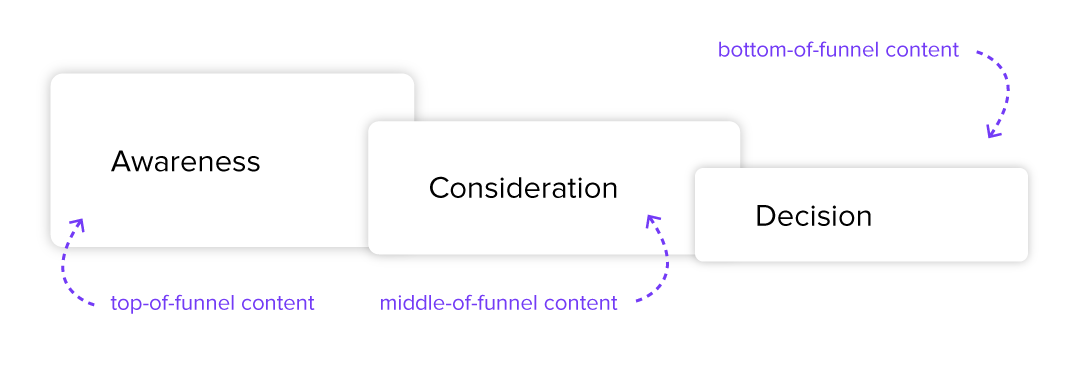
At its core, effective lead generation operates on a value exchange: you provide helpful, relevant content or experiences, and in return, your audience opts in by sharing their information or engaging further with your brand.
When done well, this creates a sustainable pipeline of engaged prospects who are more likely to convert and progress through the funnel.
Successful lead generation requires:
- A clear understanding of your ICPs and buyer personas
- Content aligned to different stages of the buyer’s journey
- Conversion opportunities across your website and campaigns
- A strategy that balances long-term organic growth with targeted paid promotion
Lead Nurturing and Lifecycle Marketing
Generating leads is only the first step, turning those leads into customers requires consistent, relevant engagement over time.
Lead nurturing (or lifecycle marketing) is the process of building relationships with prospects by delivering personalized, value-driven interactions that guide them through the buying journey.
A simplified view of lifecycle marketing in action: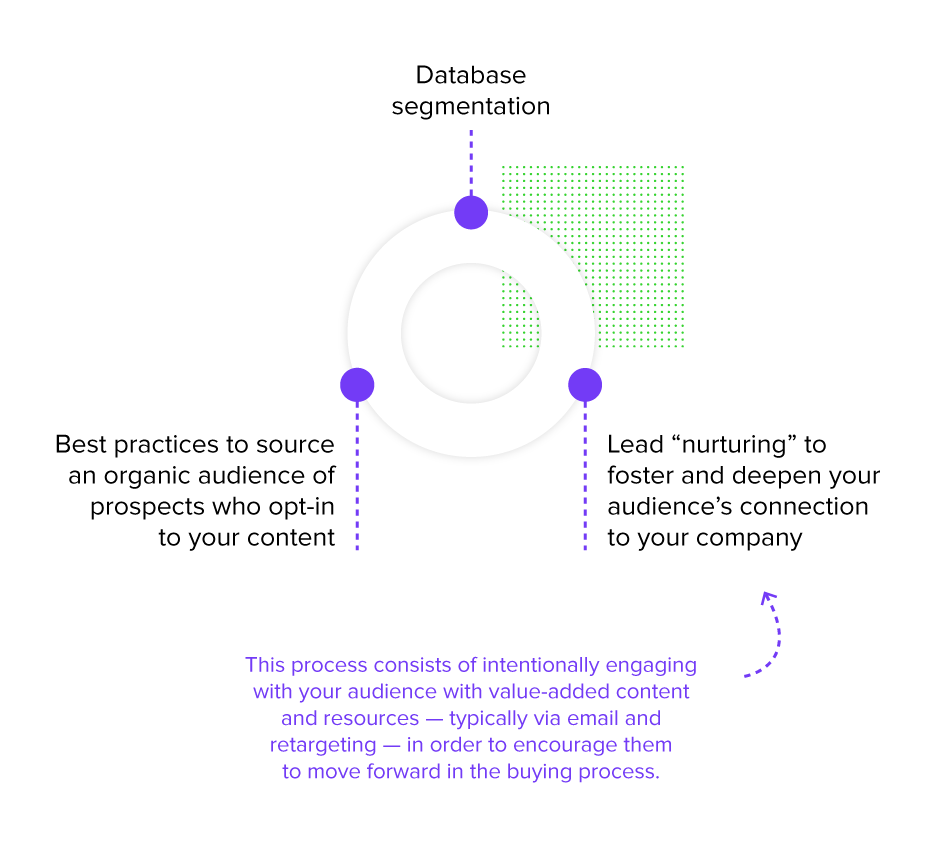
This typically involves ongoing communication through channels like email, retargeting, and on-site experiences, helping prospects better understand their challenges, evaluate solutions, and build trust in your brand.
An effective nurturing strategy enables you to:
- Stay top-of-mind with your audience
- Deliver the right message at the right time
- Build credibility and trust before a sales conversation
- Move leads efficiently from initial interest to decision
Over time, this creates a more personalized and scalable buyer experience—one that supports both conversion and long-term customer relationships.
How Customer Success Strengthens Demand Generation
Demand generation doesn’t stop at acquisition. The most effective strategies are built around the entire customer lifecycle—from first touch to retention and expansion.
That’s why aligning marketing with customer success is critical. Together, these teams ensure that what you promise in your marketing experience aligns with what customers actually experience after they convert.
Using Customer Data to Improve Demand Generation
Customer success teams are one of the most valuable sources of insight for demand generation.
By combining qualitative feedback (customer conversations, support trends) with quantitative data (churn, engagement, product usage), marketing teams can continuously refine their strategy.
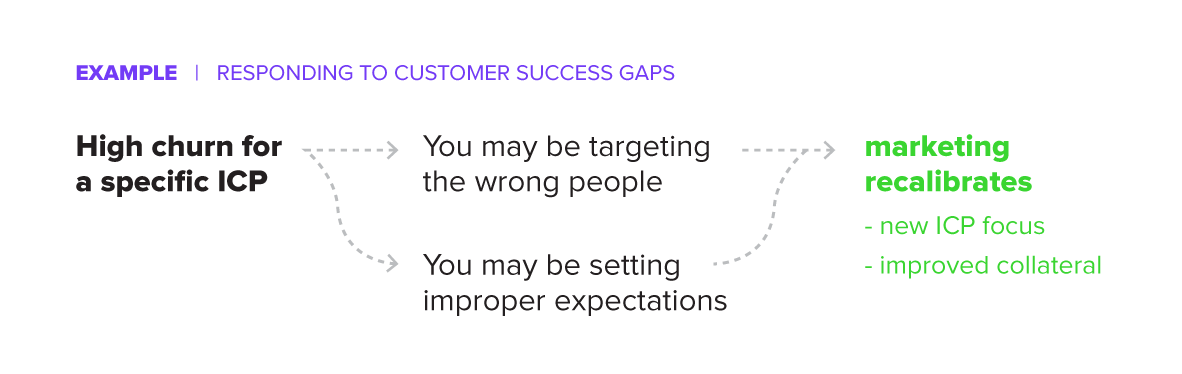
For example:
- If churn is high within a specific ICP, you may be targeting the wrong accounts
- If customers struggle after purchase, your messaging may be setting incorrect expectations
In either case, marketing can adjust by:
- Refining ICP targeting
- Updating positioning and messaging
- Creating more accurate and helpful content
This feedback loop ensures demand generation efforts are not just driving pipeline, but driving the right pipeline.
How customer data informs demand generation strategy:
Driving Retention and Expansion Through Marketing
Marketing also plays a key role in engaging existing customers—not just acquiring new ones.
By analyzing customer data such as:
- NPS and customer feedback
- Product usage and engagement
- Customer lifetime value (LTV)
…teams can identify opportunities to deepen relationships and drive expansion.
Effective tactics include:
- Customer-focused newsletters and lifecycle campaigns
- Educational webinars and events
- Exclusive content tailored to existing customers
This approach helps turn demand generation into a full-lifecycle growth engine, supporting both retention and expansion.
Revenue Operations and Enablement
Demand generation is only as effective as the revenue it produces—and the efficiency with which it converts pipeline into customers.
This has led to a shift toward revenue-focused organizations, where marketing, sales, and customer success operate within a unified strategy supported by revenue operations (RevOps).
What Is Revenue Operations?
Revenue operations is the process of aligning technology, data, and teams to drive predictable, scalable revenue growth.
An effective RevOps strategy connects systems, standardizes processes, and ensures all teams are working from the same data.
Core Components of Revenue Operations
1
System architecture and implementation
CRM and marketing automation setup, lifecycle stage definitions, lead scoring
CRM and marketing automation setup, lifecycle stage definitions, lead scoring
2
Data integration and hygiene
Ensuring clean, unified data across platforms
Ensuring clean, unified data across platforms
3
Process design and enablement
Clear handoffs, playbooks, and training across teams
Clear handoffs, playbooks, and training across teams
4
Revenue intelligence and reporting
Dashboards and analytics that provide visibility into pipeline performance
Dashboards and analytics that provide visibility into pipeline performance
Measuring Funnel Performance and Revenue Impact
To understand the effectiveness of your demand generation strategy, you need clear visibility into your funnel.
At minimum, organizations should track:
- Visitors → Leads
- Leads → Opportunities
- Opportunities → Customers
This data, typically housed in your CRM and marketing automation platform, helps identify bottlenecks, improve conversion rates, and drive more efficient growth.
4Demand Generation Channels and Tactics
At the core of both lead generation and nurturing is a coordinated set of channels and tactics that work together to attract, engage, and convert audiences across search, social, and AI-driven discovery experiences.
Lead Generation and Nurturing Tactics


Search-optimized content strategy
Content remains at the core of inbound marketing and demand generation, but how it’s created and discovered has evolved.
Today, effective strategies focus on creating high-value, search-optimized content that not only ranks in traditional search engines, but is also structured for AI-driven discovery (AEO).
Rather than publishing for volume, organizations should prioritize content that directly addresses their audience’s questions, challenges, and decision-making needs. This includes a mix of formats—from short, educational blog posts to comprehensive guides and pillar pages that establish authority.
The goal is to create content that attracts, engages, and builds trust, long before a sales conversation begins.
SEO
A modern SEO strategy goes beyond keywords to focus on visibility across both search engines and AI-powered experiences.
In addition to foundational on-page tactics—such as metadata, internal linking, and site structure: organizations should prioritize content clarity, authority, and structure to ensure it can be surfaced in AI-generated responses.
Off-page SEO, including high-quality backlinks and brand mentions, continues to play an important role in building credibility and long-term visibility.
Conversion optimization
As your site attracts visitors, the next step is turning that traffic into meaningful engagement.
Conversion optimization starts with understanding how users navigate your site and identifying opportunities to improve their experience. This includes refining user journeys, simplifying conversion paths, and delivering more relevant, personalized interactions.
Modern approaches often incorporate AI agents, dynamic content, and behavioral targeting to guide users toward the right next step—whether that’s consuming more content, engaging with your team, or entering your pipeline.
Email and lifecycle marketing
Email remains a foundational channel for nurturing prospects and engaging customers across the lifecycle.
Effective lifecycle marketing focuses on delivering timely, relevant, and personalized communication that builds trust and moves audiences forward in their journey.
Performance depends on a combination of strong segmentation, valuable content, and continuous optimization of elements like:
- Subject lines
- Messaging and positioning
- Design and user experience
- Calls to action
When executed well, email becomes a scalable way to maintain relationships and drive both conversion and retention.
Paid advertising channels
Paid media plays a critical role in amplifying your demand generation efforts and accelerating results.
Paid advertising typically falls into two core categories:
- Paid search, which captures high-intent demand by targeting users actively searching for solutions
- Paid social, which helps you reach targeted audiences who may not yet be actively looking, but fit your ideal customer profile
While paid search is effective for capturing existing demand, paid social is often better suited for building awareness and promoting thought leadership content.
The most effective strategies use both in tandem—capturing demand where it exists while also creating it through targeted exposure.
5Measuring Demand Generation Success
Demand generation is only as effective as the systems, data, and processes that support it. Revenue operations (RevOps) ensures that marketing, sales, and customer success teams are aligned—working from the same data, following consistent processes, and driving toward shared revenue goals.
By connecting these functions, RevOps transforms demand generation from a set of activities into a scalable, measurable revenue engine.
Aligning Marketing and Sales
One of the biggest challenges in demand generation is ensuring alignment between marketing and sales.
RevOps helps define shared processes across the funnel, including:
- Lead qualification criteria
- Lifecycle stage definitions
- Handoff points between teams
This alignment ensures that leads generated by marketing are properly followed up on by sales—and that both teams are accountable to the same outcomes. The result is a more efficient pipeline and a better experience for buyers.
Improving Pipeline Visibility
RevOps provides a unified view of the entire revenue funnel—from first touch through closed deal and beyond.
By centralizing data within your CRM and connected systems, teams can track:
- Where leads are coming from
- How they progress through the funnel
- Where opportunities are stalling or dropping off
This level of visibility allows organizations to identify gaps, optimize conversion rates, and prioritize the highest-impact initiatives within their demand generation strategy.
Enabling Better Forecasting and Reporting
Accurate forecasting depends on clean data, consistent processes, and clear visibility into pipeline performance—all of which are enabled by RevOps.
With the right reporting infrastructure in place, organizations can:
- Measure conversion rates at each stage of the funnel
- Forecast revenue based on pipeline health and velocity
- Attribute performance to specific campaigns and channels
These insights allow teams to make more informed decisions, allocate resources effectively, and continuously improve demand generation outcomes over time.
Ultimately, revenue operations connects demand generation efforts directly to revenue: ensuring every activity is measurable, accountable, and optimized for growth.
Ready to Build a Scalable Demand Generation Engine?
Modern demand generation requires more than campaigns—it demands alignment across strategy, technology, and teams.
New Breed helps B2B organizations design and execute demand generation programs that connect marketing, sales, and revenue operations to drive measurable growth.
From defining your ICP and building your content strategy to optimizing your funnel and implementing HubSpot, we help you turn demand into revenue.
Frequently Asked Questions about Modern Demand Generation
What is demand generation in marketing?
Demand generation is a strategic, full-funnel approach to creating awareness, building trust, and driving revenue across the entire customer lifecycle. It combines marketing, sales, and customer success efforts to attract the right audiences, convert them into customers, and support retention and expansion over time.
How is demand generation different from lead generation?
Lead generation focuses specifically on capturing contact information from potential customers. Demand generation is broader—it includes lead generation but also encompasses brand awareness, content strategy, nurturing, sales alignment, and customer lifecycle engagement. In short, lead generation is one component of a larger demand generation strategy.
What channels are most effective for demand generation?
The most effective demand generation strategies use a mix of channels, including:
- SEO and content marketing
- Paid search and paid social
- Email and lifecycle marketing
- Social media and thought leadership
- Website optimization and conversion experiences
The right mix depends on your audience, goals, and where your buyers spend time across search, social, and AI-driven discovery platforms.
How do you measure demand generation success?
Demand generation success is measured by its impact on pipeline and revenue. Key metrics include funnel conversion rates, marketing-sourced and influenced pipeline, customer acquisition cost, and customer lifetime value. Organizations should also track retention and expansion to ensure long-term growth.
What role does RevOps play in demand generation?
Revenue operations (RevOps) aligns marketing, sales, and customer success by connecting systems, data, and processes. It ensures consistent lifecycle stages, improves pipeline visibility, and enables accurate reporting and forecasting—allowing demand generation efforts to be measured, optimized, and scaled effectively.