Building a Scalable System
HubSpot Implementation: The Complete Guide to Process, Cost, and Partners

TOC
1What is HubSpot Implementation?
HubSpot implementation is the process of designing and building your HubSpot system to align with your business goals, processes, and team structure.
It goes beyond basic setup. A proper implementation defines how your entire go-to-market motion operates inside HubSpot, including:
- Lifecycle stages and funnel structure
- Sales pipelines and deal stages
- Lead routing and ownership rules
- Automation and workflows
- Data structure and reporting
A strong implementation ensures that HubSpot supports your business, instead of forcing your team to work around the system.
2HubSpot Implementation vs. Migration vs. Configuration
Understanding their roles within your HubSpot instance
Many teams confuse implementation with migration or configuration. While they are closely related, they serve different roles within your system.
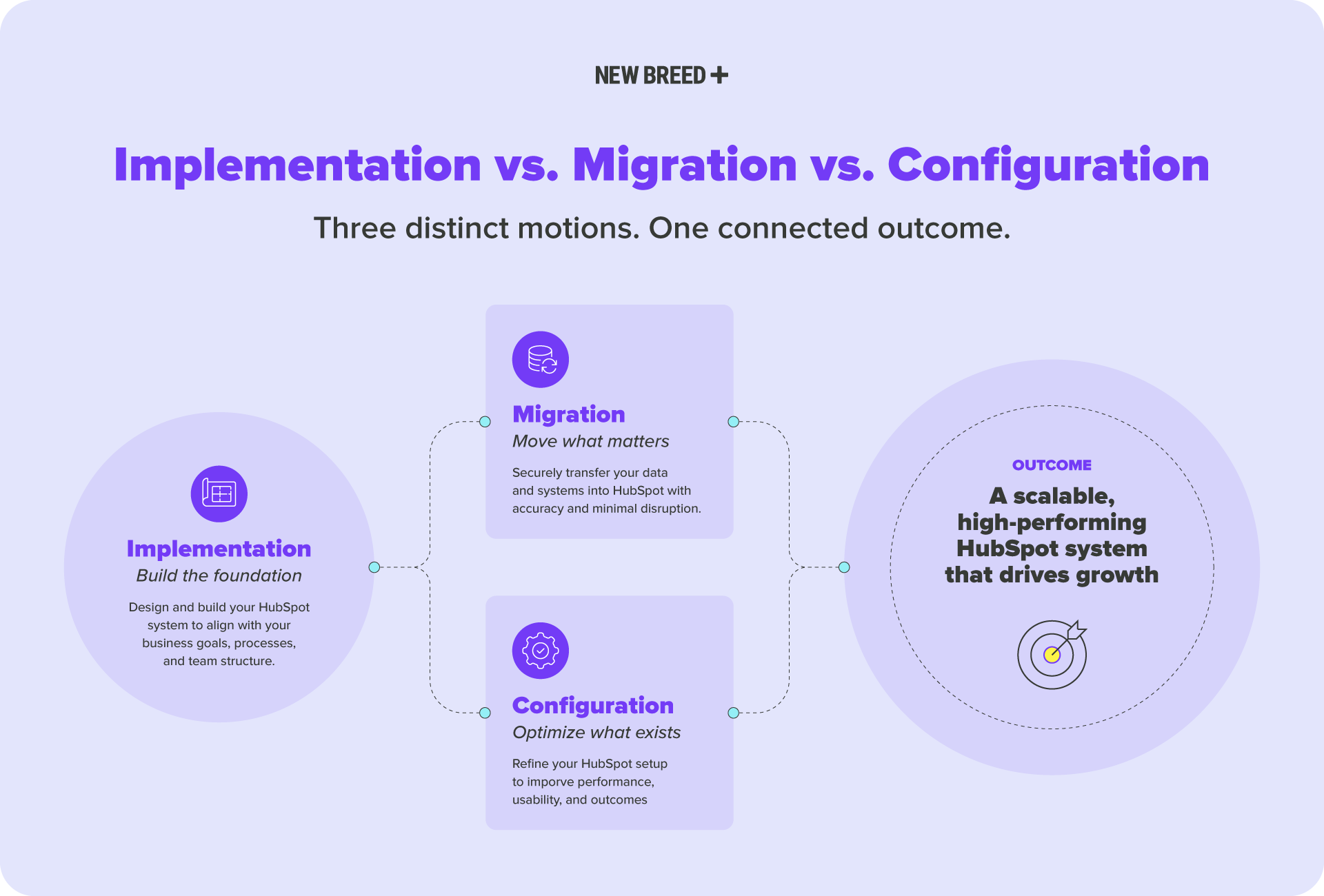
Implementation: Build the Foundation
Implementation is where strategy meets system design. This is where you define how your business operates inside HubSpot.
Migration: Move What Matters
Migration is the process of transferring data and systems into HubSpot, including contacts, companies, deals, and integrations.
Configuration: Optimize What Exists
Configuration focuses on improving and refining your system after it’s live to increase performance, usability, and outcomes.
Together, these three motions create a scalable, high-performing HubSpot system.
Learn more about differences between HubSpot implementation vs migration vs configuration.
Why HubSpot Implementation Matters for Growth
A well-executed HubSpot implementation drives real business outcomes, not just system functionality.
Faster Revenue Execution
Clear pipelines and automation reduce friction across marketing and sales.
Better Data and Reporting
A structured system ensures your reporting is accurate and actionable.
Higher Team Adoption
When HubSpot reflects real workflows, teams actually use it.
Scalable Growth
A strong foundation allows your system to evolve without breaking as your business grows.
What’s the difference between HubSpot implementation and onboarding?
HubSpot onboarding typically focuses on helping teams get started with the platform using predefined setup guidance. HubSpot implementation is broader and more strategic, covering system architecture, process design, automation, integrations, and long-term scalability.
Can you migrate to HubSpot without a full implementation?
Technically yes, but migrating data without redesigning processes and system structure often leads to poor adoption, messy reporting, and operational inefficiencies.
Is HubSpot implementation only for enterprise companies?
No. Businesses of all sizes benefit from implementation. Smaller companies may require a simpler setup, while larger organizations often need more advanced architecture, integrations, and governance.
3HubSpot Implementation Process (Step-by-Step)
5 Stages of a Successful HubSpot Implementation
Follow this structured, strategic process:
1
Strategy and System Design
Define your go-to-market motion before building anything.
-
Lifecycle stages and funnel design
-
Pipeline architecture
-
Data model and governance
-
Lead management strategy
2
System Build and Integration
Translate your strategy into HubSpot.
-
CRM configuration
-
Workflow automation
-
Integration with your tech stack
-
Permissions and team structure
3
Data Migration
Move and structure the right data.
-
Data mapping and cleanup
-
Importing contacts, companies, and deals
-
Integration syncing
-
Data validation
4
Enablement and Training
Ensure your team is ready to use the system.
-
Team training sessions
-
Documentation and SOPs
-
Process alignment
-
Early performance tracking
5
Optimization and Iteration
Continuously improve your system over time.
-
Workflow refinement
-
Reporting enhancements
-
Data cleanup
-
Process optimization
4HubSpot Implementation Checklist
Use this checklist to ensure your implementation covers all critical components:
The No Nonsense HubSpot Implementation Checklist

Define lifecycle stages and funnel structure
Map pipeline and deal stages
Clean and standardize your data
Set up core properties and fields
Configure automation and workflows
Build reporting dashboards
Integrate key systems
Test workflows and automation
Train your team
Validate data and reporting accuracy
New Breed Tip: Don't rush through training your team. Many organizations overlook the importance of user adoption and training and see their implementation fail.
5Common HubSpot Implementation Mistakes
Starting Without a Strategy
Jumping into setup without defining processes leads to misalignment and rework.
Migrating Too Much Data
Bringing over unnecessary or messy data creates long-term issues.
Overengineering the System
Trying to build everything upfront slows adoption and increases complexity.
Ignoring Data Structure
Poor property setup and naming conventions break reporting later.
Not Planning for Adoption
Without proper training and enablement, even the best system fails.
6HubSpot Implementation Timeline & Cost
How Long Does HubSpot Implementation Take?
HubSpot implementation timelines vary based on business complexity, number of hubs, integrations, and internal alignment.
Typical timelines include:
- 1–2 months for smaller, straightforward implementations
- 3–6 months for most mid-market implementation projects
- 6–12+ months for complex enterprise rollouts with extensive integrations, custom objects, or multi-team processes
Implementation timelines are often extended by:
- Data cleanup requirements
- Legacy system complexity
- Integration dependencies
- Stakeholder alignment and process decisions
- Change management and team adoption
The more strategic the implementation, the more important planning and alignment become early in the process.
How Much Does HubSpot Implementation Cost?
HubSpot implementation costs vary widely depending on scope, complexity, and the level of strategic support required.
Most implementation projects typically fall into:
- The minimum HubSpot Configuration project start around $20K
- Average involving multiple Hub or more more complex uses cases range between $35K-$50K
- There are some outliers that are very complex involving customer integrations that can run $50-100K (these tend to be corporate or enterprise level organizations)
Implementation costs are usually influenced by:
- Number of hubs being implemented
- CRM and automation complexity
- Data migration requirements
- Integration needs
- Reporting and RevOps requirements
- Team training and enablement
While pricing varies significantly from project to project, the biggest cost is rarely implementation itself, it’s rebuilding a system that was designed incorrectly the first time.
Why does HubSpot implementation take so long?
Implementation timelines are often extended by data cleanup, stakeholder alignment, integration complexity, process redesign, and change management requirements.
What impacts HubSpot implementation cost the most?
The largest cost drivers are usually:
- Number of hubs
- CRM complexity
- Integration requirements
- Data migration scope
- Custom automation and reporting
- Team training and enablement
Can HubSpot implementation be done in phases?
Yes. Many companies implement HubSpot in phases, starting with foundational CRM setup before expanding into marketing automation, customer service, reporting, or advanced RevOps workflows.
7Should You Hire a HubSpot Implementation Partner or Agency?
Choosing the right support model depends on your complexity and goals.
What Does a HubSpot Implementation Consultant Do?
A consultant helps design your system, define processes, and guide implementation strategy.
When to Hire a HubSpot Implementation Agency
An agency is best when you need:
- End-to-end implementation support
- Cross-functional alignment (marketing, sales, service)
- Data migration and integrations
- Faster time-to-value
How to Choose the Right HubSpot Implementation Partner
Look for:
- Proven experience across hubs
- Strong RevOps and CRM strategy expertise
- A structured implementation process
- Clear focus on business outcomes, not just setup
HubSpot Implementation Services at New Breed
At New Breed, HubSpot implementation is built around one goal: driving meaningful growth.
We combine strategy, system design, and execution to build a HubSpot environment that aligns with your entire revenue engine.
Our approach includes:
- Strategic system design
- Full CRM and automation build
- Data migration and validation
- Team enablement and training
- Ongoing optimization
We don’t just implement HubSpot. We build systems that perform.
Build Your HubSpot System the Right Way
HubSpot is only as powerful as the system behind it.
A thoughtful implementation ensures your platform supports your processes, empowers your teams, and drives measurable growth.
Talk to a HubSpot Implementation Expert
Ready to get more out of HubSpot?
Work with a certified HubSpot implementation partner to design and build a system that actually drives results.
Frequently Asked Questions About HubSpot Implementation
What is included in HubSpot implementation?
HubSpot implementation typically includes CRM setup, lifecycle stage design, pipeline configuration, workflow automation, reporting, integrations, data migration, and team training.
How long does HubSpot implementation take?
Smaller implementations may take 1–2 months, while more complex implementations often take 3–6 months or longer depending on integrations, data complexity, and organizational alignment.
How much does HubSpot implementation cost?
Implementation costs vary based on scope and complexity. Smaller implementations often fall into the low five figures ($20k), while larger multi-hub or enterprise implementations may reach $25K to $100K depending on complexity and custom integrations.
Do I need a HubSpot implementation partner?
Not every company does, but organizations with complex processes, multiple teams, integrations, or large-scale migrations often benefit from working with an experienced HubSpot implementation partner.
What’s the difference between HubSpot onboarding and implementation?
Onboarding helps teams get started with HubSpot, while implementation focuses on designing and building a scalable system aligned to business operations and growth goals.
Can HubSpot implementation include data migration?
Yes. Many implementation projects include migrating contacts, companies, deals, historical data, and integrations from legacy systems into HubSpot.
What are the biggest HubSpot implementation mistakes?
Common mistakes include:
- Starting without a strategy
- Migrating poor-quality data
- Overengineering workflows
- Ignoring reporting structure
- Failing to plan for user adoption
What should I look for in a HubSpot implementation agency?
Look for a partner with:
- Cross-functional HubSpot expertise
- RevOps and CRM strategy experience
- Proven implementation processes
- Strong change management capabilities
- Experience with integrations and data architecture